

China identifies new lunar mineral
Chang’e-5 samples reveal rare earth-rich moon mineral
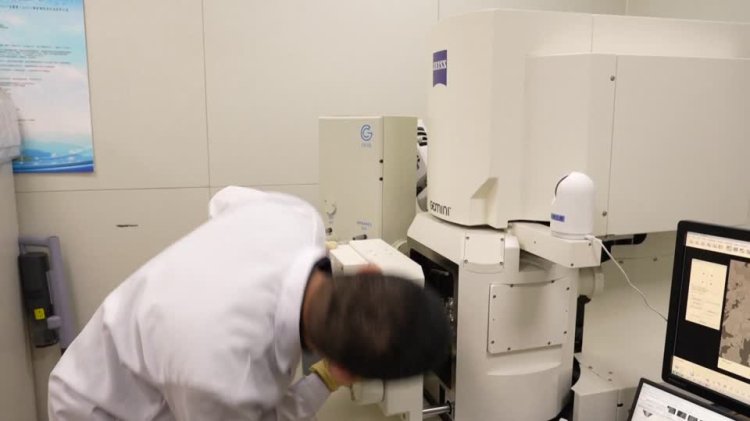
A Chinese research team announced the identification of a new lunar mineral, changesite‑(Ce), from samples returned by the Chang’e‑5 mission, marking the third novel mineral reported from those samples alongside magnesiochangesite‑(Y) and magnesiochangesite‑(Ce). The discovery emerged unexpectedly during microscopic examination of lunar material when scientists, initially investigating variations of merrillite, noted numerous tiny granules with an unusual composition enriched in light rare earth elements. Detailed analysis revealed these granules to be a previously unrecognized phosphate mineral dominated by cerium.
Researchers from the Chinese Academy of Geological Sciences led the work. Team members recounted how the shift from a routine scan to a focused mineral‑identification effort accelerated once the anomalous composition was spotted; naming priority rules from the International Mineralogical Association prompted the group to rapidly compile evidence to validate the find. The identification process combined scanning electron microscopy with systematic mineralogical characterization to confirm changesite‑(Ce)’s distinct chemistry and structure.
The find expands understanding of lunar geochemistry, demonstrating the Moon hosts more chemically diverse minerals than earlier samples indicated. Changesite‑(Ce)’s light rare earth enrichment contrasts with changesite‑(Y), discovered in 2022, which is rich in heavy rare earths, suggesting localized processes on the lunar surface or in its magmatic history can concentrate different rare earth elements into distinct mineral phases. Scientists say such variation offers clues about lunar formation, differentiation and the distribution of economically and scientifically important elements.
The discovery underscores the scientific value of sample‑return missions: laboratory studies on Earth can uncover subtle mineralogical features not resolvable by remote sensing or in‑situ instruments. It also highlights China’s growing role in planetary science and the collaborative, competitive environment surrounding new‑mineral naming. Researchers plan further studies to map occurrences of changesite‑(Ce) within the Chang’e‑5 material, probe its formation conditions, and compare it with lunar and meteorite minerals to refine models of the Moon’s geological evolution.