

Soft exosuit trouser aids astronauts
Bristol team tests garment to cut fatigue and preserve muscle
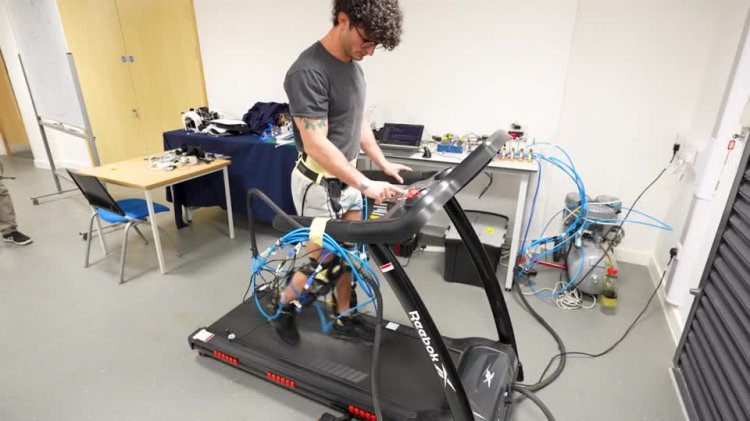
Researchers at the University of Bristol have developed a soft robotic “exosuit” trouser intended to be worn beneath a spacesuit to assist movement and reduce lower‑limb fatigue during lunar and Martian surface operations. The fabric‑based garment uses inflatable artificial “muscles”—an airtight inner thermoplastic layer wrapped in nylon, anchored with high‑strength components such as a Kevlar waistband and knee straps—to deliver targeted bursts of assistive force during walking, climbing and load‑carrying. A separate resistive configuration adds dynamic loading to help maintain muscle mass; developers aim to merge both functions into a single hybrid garment.
The prototype was field‑tested in a simulated lunar terrain environment at the University of Adelaide’s Exterres CRATER facility as part of an international analog mission. Researchers reported positive subjective feedback on comfort and perceived assistance, alongside biomechanical data showing reduced muscle activation and improved joint kinematics, indicating the system’s effectiveness in reducing muscular effort while preserving natural motion. Developers highlighted the suit’s lightweight, clothing‑like form factor as an advantage over rigid exoskeletons that can restrict joint movement.
Designers say the exosuit could help address two major challenges for long‑duration planetary missions: the extra effort required to move inside pressurised suits and the rapid muscle weakening that occurs in reduced gravity despite daily exercise protocols. By providing assistance during tasks and/or adding intermittent resistance throughout the day, the garment could both conserve astronaut energy during sorties and complement onboard exercise regimes to slow deconditioning.
Beyond spaceflight, the team sees applications on Earth for mobility support and rehabilitation, where assistive or resistive modes could aid patients or workers. Remaining hurdles include improving comfort (noted in early trials), ensuring reliability in dusty, temperature‑extreme and radiation‑exposed environments, minimising power consumption, simplifying donning and maintenance, and completing extensive testing—including potential station‑based trials—to validate long‑term safety and effectiveness. Researchers also emphasise the need to study user trust, ease of override and psychological acceptance before operational deployment.