

Humanoid robots race in Beijing event
Robots competed with humans in a 21 kilometer test of endurance and autonomy
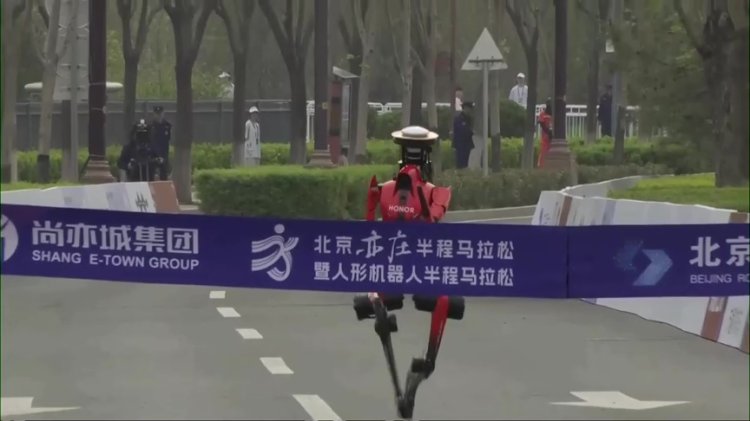
More than 300 humanoid robots competed alongside human runners in a 21-kilometer event in Beijing that doubled as a live testbed for robotics hardware, algorithms and endurance ahead of possible mass production and deployment. Robots ran in parallel lanes to avoid collisions; roughly 40% navigated the course autonomously rather than via remote control. Organizers framed the race as a practical experiment to evaluate real‑world navigation, stability, energy management and thermal control under sustained load.
Performance improved sharply from last year: while many machines failed to finish in the inaugural edition, the fastest robots this time were on pace to complete the half-marathon in under an hour. A red-clad model developed by smartphone maker Honor won in 50 minutes 26 seconds, beating all 12,000 human participants in the conventional race and surpassing the recent human half‑marathon world record by several minutes; Honor also claimed second and third places. Engineers credited advances such as liquid‑cooling systems—adapted from smartphone technology—for improved endurance and reliability.
Teams used the event to collect telemetry on balance, pacing, battery life and thermal performance, and to refine control algorithms against uneven terrain and variable speeds. Some entrants still required assistance, underlining ongoing challenges, but the overall progress highlighted rapid gains in speed, stability and autonomy. International collaborations were visible, with visiting university teams reporting constructive partnerships with Chinese researchers.
Industry officials and insiders argued the demonstration narrows the gap to commercialization, saying faster iteration, falling costs and scaling production could create a “flywheel” accelerating wider adoption in manufacturing, logistics and service sectors. Organizers and engineers emphasized that while fully autonomous humanoid robots remain under development, competitions like this provide crucial data and engineering momentum toward real-world deployment.